
After he was placed into Karee, he proceeded to fall in love with UFS’s dorm culture. His favorite ritual was freshman initiation. He laughed as he described it to me, because he recognized that it seemed an unlikely memory to cherish. “We queued blindfolded and half-naked,” he recounted. Seniors painted the freshmen’s bodies in red and yellow stripes to resemble the dorm mascot, a bee. Then they made each initiate drink tomato juice from a toilet bowl. “It looked like vomit! It was horrible! Guys were really getting sick!” Finally, the freshmen were led to a “huge drum filled with water, cow dung and grass.” A senior shouted at them to dyk—dive! “Then you get out. You’re dripping, smelling like cow dung.”
After the cow-dung dip, the black and white freshmen were instructed to go back to their rooms, shower, change into a jacket and tie, and head to the dorm courtyard, where smiling seniors were waiting to hand them a plate of barbecued meat and a beer. “You are a member now,” they informed Mathibela. “Color doesn’t count.”
“I felt proud,” he remembered.
Like Mathibela, most of the first black students to brave UFS were gung-ho about the dorm culture. UFS had been closed to them, and it was thrilling to be let in and to belong. Another former black student who lived in a mostly white dorm in the early 1990s told me he felt like he was “ascending.”
Their enthusiasm made the white students feel as if they had something worth sharing, bolstering their sense of pride. Mathibela recalls that a white student named Coenraad Jonker pulled him aside. “Where did you learn to speak such beautiful Afrikaans?” he marveled. “You are definitely going to make it here.” White students even bent some of the dorm rules to make it easier on the black students.
And yet, said Mathibela, “I knew it could not last.” As his second and third year ticked by, he was still enjoying himself. But others were starting to grumble. “There were talks that there was going to be a huge change,” he said.
One night, the black students in his dorm gathered in his room. They had been drinking a little, and tongues were loosened. A boy named Shadrack Modise—the boy in yellow in the first integrated 1992 dorm photo, the one with the ironic, perhaps even mocking smile—declared he was having doubts about the dorm’s traditions. Blacks had their own traditions, he pointed out. Most of South Africa’s black tribes have months-long initiation rites administered when a boy is around 16. Blacks are already men by the time they go to university.
He also called attention to the way some of the dorm’s traditions eerily perpetuated old South African power dynamics. Freshmen were forced to wear lackey’s uniforms, address seniors by honorific titles, walk through back doors. These were exactly the things their parents had to do under apartheid. Why should they, free black youth, now do it voluntarily? “This whole thing,” Modise concluded before his rapt audience in Mathibela’s room, “amounts to shit.”
Not privy to the new feelings developing behind closed doors, the administrators thought integration was going astoundingly well. Billyboy Ramahlele recounted his feelings of joy: “Whenever there was a soccer match [in Bloemfontein], I would take a van full of black and white people,” he reminisced, smiling happily. Everybody had expected rural UFS to be a hard nut to crack in terms of integration. But “this university was more advanced than any of its Afrikaans counterparts,” Ramahlele recounted. President Nelson Mandela agreed to accept an honorary doctorate in recognition of UFS’s great strides. “Everybody was talking about us—that we were dealing with these problems so well.”
At the same time, the university reached out to bring in more black students in recognition that the Free State was about 85 percent black. Ramahlele helped lead a radio campaign to recruit black students aggressively. “Every year it [the black cohort at UFS] doubled, doubled, doubled,” he said.
But as more black students arrived, the power balance on campus started to shift. Teuns Verschoor, now one of the university’s vice presidents, was then the administrator in charge of student life. A fatherly mentor type, he is lanky and shaggy-haired and gambols around campus in a brown suede jacket and old-fashioned wool tie, parrying constantly with students. “We started off with 10 percent [black students] in the dorms,” he said. “That was quite something. It was now real contact. But they just fell in with the house cultures. They even decided to start playing rugby—the favorite Afrikaner sport.” When the black student population reached 30 percent, though, “then they started establishing their own identities.”
Everybody I talked to connected with UFS’s history mentioned the number 30 percent. It was a demographic hot line—when the feelings of a few dissidents like Shadrack Modise became the feelings of the whole cohort and black students stopped wanting to go along with the white students’ traditions. They wanted dorm culture to reflect their culture—black culture. They wanted soccer, the black sport, on the common room TV, not rugby.
Choice Makhetha was one of the first black students to join the student council in 1996. There, she fielded a growing number of black complaints. “In one dorm, when you turned 21, you had to run naked,” she remembered. “For black guys, the culture does not allow a 21-year-old guy to run naked with his penis out.”
Verschoor, whose rumpled approachability made him a natural confidante to white and black students, remembered the complaints: “A lot of black students started asking me questions,” he said. “‘Why do we have to do this tradition or that tradition?’” He held meetings in the dorms to discuss tweaking the practices that were bothering the black students. But as soon as the black students started objecting to the traditions, the white students seemed to close ranks. “Even the white students who actually didn’t like running around naked—it became important to them,” explained Makhetha.
Arnold Bender, a self-described fun-lover, was one of the white students holding up the old South African flag in the 1997 Karee dorm photo with cheeky pride. He recalled that conflict arose over “telephone service,” a tradition wherein freshmen had to man a telephone in the lobby in shifts. As a freshman in 1993, he hadn’t especially enjoyed the duty. But he experienced the black critique of telephone service as an assault on his dignity. “Why should a white freshman do an extra hour of telephone service just because somebody else thinks it’s below him?” he asked me.
He wondered if the black stand against telephone service was about more than just the irritation of answering telephones. “I thought there was some sort of an intent against Afrikaner things,” he said. The restiveness of his black peers made him aware that the tide of things was going against Afrikaners nationally, and made him fear that bigger changes might be in the offing. “I remember one guy told me, ‘It’s discriminatory that the whole university is Afrikaans. They should change it to English.’”
The white students had been eager to incorporate the black students into their institutions—on their terms. They hadn’t foreseen that the black students might want the institutions to change to reflect their own preferences. Frederick Retief, the then-president of the university, remembered “having discussions with angry students who said that when they said yes [to integration], they didn’t say yes to this.”
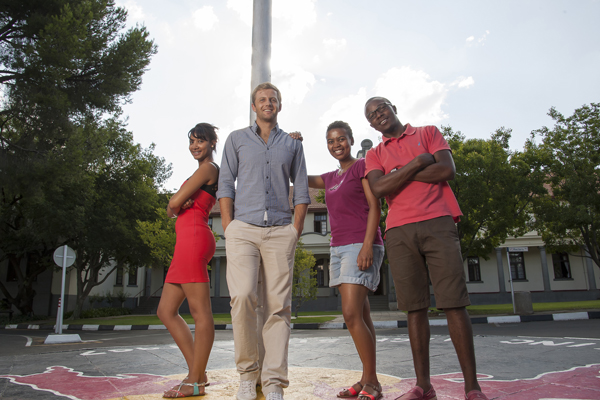
Andricia Hinckemann, Abel Jordaan, Emme-Lancia Faro & Phiwe Mathe. © Sonia Small

In many ways, the students at UFS were acting out a greater national drama. When South Africa transitioned to democracy in 1994, the first priority was emotional reconciliation. Over time, though, the theme switched to economic and social transformation. The freed black majority wanted to see material evidence of their bettered status. And yet South Africa’s institutions—business, agriculture and the arts—remained disproportionately white-designed and white-dominated.
Thus, in the second half of the 1990s, the races that had initially come together in South Africa with astonishing joy began to regard each other more warily. Thabo Mbeki, South Africa’s second democratically elected president, proposed a sweeping affirmative action plan and resentfully spoke of “two South Africas,” implying the whites had refused to give up anything of value. Afrikaans town names were changed to blacker ones, and Afrikaans-language schools were shifted to English.
The Afrikaners, for their part, were shocked to learn that the new democracy would result in a seizure of physical and psychological ground. In 1995, F.W. de Klerk, the last apartheid-era president, resigned from the government of unity he’d created with Mandela, alleging the new black leadership refused to treat Afrikaners respectfully. By 1998, a poll showed half of Afrikaners agreed with the statement “South Africa today is a land for blacks; whites will have to accept that they will take second place.” That figure is no surprise—blacks comprise an 85 percent majority of the South African population nationwide, reflecting the demographics of the Free State. The surprise is that when the same poll was done six years earlier, in 1992, a mere four percent of Afrikaners had imagined that whites would have to substantively make way after democracy came.
UFS dorms were a microcosm of the new tensions, with young men jockeying for control of physical space. “Black student leaders would return from speaking to me and find people had ejaculated on their blankets,” Verschoor recalled. “And the black guys would form impis”— a Zulu battle line—“and boom, boom, boom, march through the white corridors. It was war.”
The February 1996 campus battle that Billyboy Ramahele witnessed was a turning point. “Huge numbers of police came,” he remembered. The black students who had run out of his dorm retreated once they glimpsed the line of white boys singing the apartheid-era national anthem. But on their way back to their dorm they “smashed all the cars” of the whites parked on the campus road. Then “they locked themselves in” to their dorm. The white boys followed them and began to break the residence’s windows. “There was no windowpane left.” The black boys were afraid to go to bed for fear hostile white contingents would enter through the holes where their bedroom windows had been. “The whole night we slept in the corridors.”
The episode reminded him eerily of the apartheid-era conflict of his youth. Ramahlele grew up in a squalid blacks-only township 35 miles east of Bloemfontein, and multiple times, he had seen gun-swinging white policemen burst into the corrugated-aluminum shack of his mother or his aunts, often while humming snippets of Die Stem.
As he saw it, here on the UFS campus, the white boys seemed to be acting out the military parts their fathers had played in the 1980s, when there was a draft for white men and flanks of white soldiers patrolled the restive black slums putting down protests. The black boys were acting out the roles of the opposition guerilla fighters. The morning after the battle, maids found a stash of Molotov cocktails hidden in the basement of Ramahlele’s dorm—the same kind of bombs Ramahlele used to fashion during his days as an anti-apartheid protester.
The battle convinced the administration that integration could not go on. Ramahlele’s dorm had already, unofficially, gone all black. Its extra rooms had become a refuge for the dissatisfied black students who couldn’t stand to stay in their white-majority dorms. As blacks came to dominate the space, the whites drifted away. Students from other dorms followed suit: Blacks from one dorm came to Makhetha and said, “If we continue to stay together, we will kill each other.” Whites from another dorm visited Verschoor and begged, “Please let us move out.”
So the administrators did. Although segregated dorms never became an official policy, informally the school let students separate. In Karee, the school even let the students put up plywood separating the black and white corridors. The east side of the building became the white side; the west, black.
Verschoor remembers the banal phrase that popped into his head as he watched the plywood go up: “It’s a pity.” But it was also a huge relief. “Suddenly, there was no battle between black and white. And we thought, well, maybe this is the recipe for now.” Like other administrators, he hoped the re-segregation would be temporary.
The fraught race relations at UFS remained a Bloemfontein secret until 2008, when four white boys filmed themselves mock-hazing their black dormitory staff, three cleaning ladies and a male gardener. In the ten-minute clip, they subjected these black elders to a beer-drinking contest, a footrace and a rugby match. The video culminated with a ritual in which the janitors were made to kneel at the boys’ feet and slurp a muddy-looking concoction out of dog bowls. Just before they drank, the reel cut to one of the white boys pretending to pee into the bowls.
After the video was posted on YouTube by one boy’s spurned girlfriend, angry protests broke out on campus, classes were cancelled, and the international news media descended on the university. Foreign reporters took the video to reveal that whites had never accepted blacks outside of South Africa’s cosmopolitan cities of Johannesburg, Cape Town and Durban. “Racial apartheid lives on in South Africa’s rural provinces, its small city campuses (like the University of the Free State) and schools, as well as its small towns and farming districts where things have not changed much,” concluded the South African-born, America-based commentator Sean Jacobs in The Guardian.
Even locals came to that conclusion. In the years-long stream of commentaries on UFS in the South African press, the university’s brief period of integration was never mentioned. Most South Africans I speak to express surprise to hear that blacks and whites originally lived together at UFS at all. Eusebius McKaiser, a prominent local talk-radio host, said to me: “That is a very different story than the one we South Africans told ourselves at the time of the video incident.”
It was an easy conclusion to draw. By early 2010, the polarization on campus was absolute; that integration had once flourished there was virtually unimaginable. It was normal to interpret disagreement as functions of innate cultural differences. “I had a fight with a girl who referred to me as ‘you people,’” Kefiloe Manthata, a black senior, told me. “I assumed she was referring to black people. Even the most colorblind person,” she explained, “comes here and develops a color way of thinking.”
Braam van Niekerk, a white senior, assured me that profound, inborn differences in psyche and worldview were what kept the races apart. I asked him what these differences were. “Oh, there are so many,” he insisted. “For example, we party on Friday nights. They like to party on Sunday, during the day.”
By this time Billyboy Ramahlele had given up. He could never accept the segregated dorms, and once, sitting in an administration meeting about them, he had a vivid fantasy of the entire campus on fire. “I thought, ‘Let this university go to rubbish! Let it burn!’ And I felt this headache in the back of my head. It wouldn’t go away for a week.” He was diagnosed with hypertension and post-traumatic stress.
5 thoughts on “A House Divided”
What an inspiring article. I hope we can see similar integration and discussion at campuses in the US, UK and Australia.
Its encouraging to see that we as a people and a nation are still capable of learning. The pioneering efforts of leaders such as Jansen become even more indispensible as South Africa strives to heal from the scars of a segregated legacy and one can only hope other nations such as the Americans, who are on the verge of an explosion of the rise in the precent of people of colours in the populations, can learn from the South African experience and hopefully handle the subsequent ‘labour pains’ better.
Amazing piece about the difficulties around integration – and how it’s an uphill battle that has to be deliberately fought, rather than just allowed to run. Sweden, the UK, France and the US could learn a lot from the South African experience.
A magisterial article – down to the merest detail of South African language and culture. I will look for more by Eve Fairbanks.
Thank you for the excellent article and the sentiments therein. It was mentioned that racism might be inherent. I believe it is also known as part of the sin nature. We can be sure that it will never be “eradicated,” anymore than poverty, which the Bible tells us “will be with us always.” Not too many people are aware of God’s viewpoint on racism in the Torah. In Numbers, Chapter 12, verse 1, there is a description of an argument against Moses involving his brother, Aaron and sister, Miriam, regarding their “racist” attitude towards Moses’s black wife (described as a Cushite or Ethiopian.) The LORD was angry and punished Miriam at this time. Not much has changed in all these centuries. God hates racism still and we can do what we can to rectify the situation, as with poverty, but need to understand the root cause…sin. That leads us to introspection…it all begins in the heart . Let’s first look in the mirror…the Bible does a good job acting as a mirror. Read it and “get the picture”. It’s the truth; believe it!