
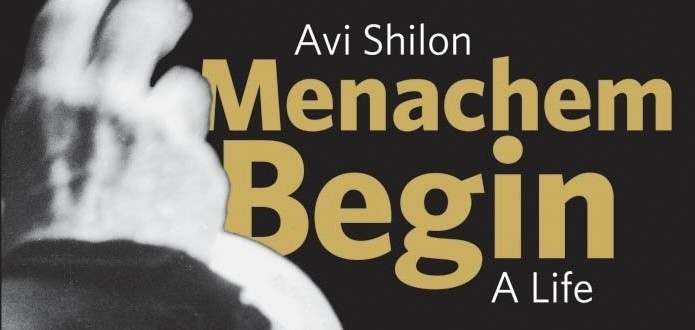
Israel’s Unlikely Peacemaker

Avi Shilon
Translated by Danielle Zilberberg and Yoram Sharet
Yale University Press
2013, $36.00, pp. 584
Menachem Begin, Israel’s sixth prime minister, who died in 1992, was among the legendary Zionist giants who shaped Israel’s destiny and the modern history of the Jewish people. Shimon Peres is the last of that founding generation of Israeli leaders. He will turn 90 later this year. To read a biography of Begin, therefore, is to go back in time and revisit those dramatic events that led to the creation of the Jewish state, its early struggle for survival, its moments of triumph and its growing pains. But it is to see them through the lens of an outsider—a revisionist Zionist ideologue who fought British rule with the tools of terror and Labor Zionist rule with defiance and rhetorical resistance. The outsider who eventually became the insider, Begin presided over Israel’s fate for five tumultuous years, from 1977 to 1983, during which he made peace with Egypt, withdrew from Sinai, won the Nobel Peace Prize, bombed the Osiraq nuclear reactor, and got the Israeli Army stuck in Lebanon on an ill-fated exercise in derring-do that lasted a decade and resulted in the rise of Hezbollah.
Avi Shilon, an Israeli journalist, has done an admirable job tracing the wellsprings of Begin’s complex personality from his early days as a youthful Beitar Commissioner in Poland, touched by Jabotinsky’s ideological zeal but determined to outflank him through advocating for greater militancy, to his rise to the leadership of the Irgun and its revolt against the British Mandate in Palestine, to his many years in the political wilderness as the leader of the right-wing political party Herut, and finally to his ascent to power as head of Likud. As Shilon admits in his conclusion, Begin’s passing from power 20 years ago marked the end of an era of ideological leadership that is unlikely to return to Israel and would be ill-suited to current times if it did. So why bother with a voluminous biography of a former Zionist icon who ended his political life in self-imposed seclusion?
For this reader, it was a chance to answer some questions that have long been bothering me about the political and ideological origins of the Likud party that Prime Minister Netanyahu now leads. Was Begin a terrorist, as is often claimed by those who seek to justify Palestinian terrorist acts? When the right wing in Israel today so disparages the idea of peace with Israel’s Arab neighbors, how did their greatest leader come to give up all of Sinai and evacuate the settlements there in favor of peace with an Arab country? What does Begin’s decision to bomb the Iraqi nuclear reactor in 1981 tell us about Netanyahu’s hesitancy to do the same to Iran’s nuclear program today? And finally, how would Begin have resolved the Palestinian problem?
To be fair to Shilon, this was not the purpose he set for himself, which seems to have been to assess as objectively as possible “the personal history of one of the most fascinating leaders of modern Israel.” But it is surely Begin’s influence on modern Israel that matters, and here the book turns out to be disappointing in its analysis and conclusions. Shilon is more concerned with faithfully tracing the tumultuous events that marked Begin’s rise and fall than he is with a deeper understanding of the consequences and implications of the history that he made.
Nevertheless, the revisit is worthwhile in many respects. Begin had no doubt about the righteousness of his cause and the justification it provided for terrorist attacks that caused the loss of innocent life even as their targets were British rule. His order to bomb British headquarters at Jerusalem’s King David Hotel in 1946 took little account of the fact that the hotel was crowded with civilians. He was assured they would be alerted in time and took no steps to make sure that was in fact the case. The explosions killed 91 people; 476 were injured. The Irgun’s attack on the Palestinian village of Deir Yassin two years later reveals a similar lack of control or attention to detail on Begin’s part. His men were ordered into battle without proper means of communication; the truck with the loudspeaker, intended to warn the inhabitants to leave the village, got stuck in a ditch. At least 100 villagers were killed in the operation, most by indiscriminate use of hand grenades by Irgun members who came under fire. Similarly, with the Irgun’s attack on the Arab town of Jaffa, adjoining Tel Aviv, which resulted in some 75,000 of its 80,000 citizens fleeing, Begin had in fact ordered a retreat, but his forces overran the town anyway and blew up buildings there, generating the mass flight.
It would take Begin almost 30 years, and the disaster of the 1973 Yom Kippur War to break the Labor Zionists’ grip on power and finally assume the leadership of the country that had been his lifelong ambition. One of his first acts was to appoint Ariel Sharon as minister of agriculture and chairman of the Committee for Settlement Affairs, a decision that he knew would result in widespread, often illegal, settlement activity. In presenting his government to the Knesset he included in its founding principles the “unassailable right” of the Jewish people to the “Land of Israel.” But he was also highly sensitive to his own, and therefore Israel’s, image in the foreign media. He wanted to leave his mark on history as a statesman, not as the Irgun commander. He was also alarmed at reports of a pending crisis in U.S.-Israel relations. So he committed himself to the pursuit of peace with Egypt and Jordan and appointed Moshe Dayan, Golda’s discredited defense minister, to the Foreign Ministry to help him. But there was another calculation behind Begin’s peace strategy. As Shilon demonstrates, Begin saw the relinquishment of Sinai “as a suitable means of relieving much of the international pressure over Judea, Samaria and Gaza.” As Begin would exclaim to those of his followers who stridently objected to ceding any inch of Arab land, “But Sinai is not part of the Land of Israel, even according to the Bible!”
Although Begin’s peace deal with Sadat, in which Israel returned all of Sinai to Egypt and evacuated all of the settlements that had been built there, was understood by the international community to have established the precedent for peace with Israel’s other neighbors, including the Palestinians, that was not Begin’s intent at all. A peace agreement that would transform Israel’s strategic circumstances had a tactical benefit for the leader of the Likud: It would facilitate the strengthening of Israel’s grip on the West Bank. Sharon’s decision when he became prime minister in 2000 to withdraw from Gaza and evacuate all the settlements there sprang from exactly the same calculation of the most effective way to ward off international pressure to give up Judea and Samaria.It helps explain a similar impulse on Netanyahu’s part that produced his willingness to give up all of the Golan Heights to Hafez al-Assad in 1998, and to try again with Assad’s son before the outbreak of the Syrian revolution two years ago.
Would Begin have come around to support the idea of an independent Palestinian state in the West Bank and Gaza? It is highly doubtful. His plan, introduced at the first Camp David summit, was to provide the Palestinians of Judea and Samaria with autonomy over their own affairs. Sovereignty, however, would remain in Israel’s hands: They would have rights on the land but would be denied rights to the land. They would be allowed to establish a police force and would be given a choice of Israeli or Jordanian citizenship, and as Israeli citizens they would be allowed to settle anywhere within Israel’s borders. Begin clearly recognized no demographic threat to the Jewish nature of Israel. And so it is with Begin’s Likud Party today. While Prime Minister Netanyahu may give lip-service to the two-state solution, his party will not support an independent Palestinian state in the West Bank. Indeed, when Sharon and Ehud Olmert came to the conclusion that the demographic threat required a two-state solution, they had to break away from the Likud and establish their own party for that purpose.
The Irgun commander still lurked within the statesman too. Just as Begin made peace with Egypt, he did not hesitate to make war when he judged that circumstances warranted it. His decision to strike Iraq’s nuclear reactor was, according to Shilon’s account, quite straightforward. Despite the opposition of the generals (both in uniform and some of those who had since become cabinet ministers) and of Shimon Peres, his rival for the prime ministership in the looming elections, Begin’s mind was made up. It was his duty to “confront the greatest threat that ever loomed over the State of Israel.” No doubt the electoral benefit of a successful operation was part of Begin’s calculus, but he was taking a huge political risk as well if the operation went wrong. Yet for Begin it was the principle of the thing: Never let an enemy country possess a nuclear weapon. Consideration of the impact of his decision on relations with the United States seems to have had limited influence on his calculation, although Shilon pays little attention to this dimension, claiming with scant evidence that Secretary of State Alexander Haig (Shilon identifies him as secretary of defense) gave him a “green light.” One can well imagine that if Begin were Israel’s prime minister today, he would have ordered the attack on Iran’s nuclear facilities a long time ago.
Whether it was making war or making peace, Begin’s penchant for the big bet proved in the end to be his undoing. The war he launched on Lebanon in 1982, at the height of his powers, was driven by his concern for the security of the citizens of northern Israel. But his grandiosity got the better of him, leading to his endorsement of Sharon’s plan to remake Lebanon as a Christian-controlled ally at peace with Israel. Shilon makes clear that while Sharon may have taken liberties with his instructions, the overall concept was Begin’s and consistent with his modus operandi going back to the early days of the struggle for independence: He never was much interested in the details of operations. When it all went awry, he resigned his office and lived out his days in virtual seclusion.
At the end of the book, Shilon raises the intriguing possibility that Begin suffered from bipolar disorder. Certainly the extreme mood swings that Shilon documents throughout the recounting of Begin’s political life, and particularly at the end, lend credence to that conclusion. We shall never know for certain since Begin was never treated by a psychiatrist, but the dualism in his personality certainly manifested itself in his bold and decisive actions and his eventual retreat into self-imposed ignominy. He was brilliant at galvanizing his followers with a fire-and-brimstone speech, yet he was incapable of managing the practical affairs of state—his handling of the economy proved disastrous. His lasting impact, according to Shilon, is the stamp he put on the Jewish character of the State of Israel. But the ultimate ironic verdict of history will likely be different: That by making peace with Egypt, unleashing the settlement enterprise in Judea and Samaria, and thereby ensuring Israel’s frozen grip on the West Bank and its burgeoning Palestinian population, he managed to lay the foundations for the undermining of the Jewish character of the state.
Martin Indyk is vice president and director of the Foreign Policy Program at the Brookings Institute, and twice served as U.S. ambassador to Israel during the Clinton administration.