
By Sarah Posner
The time has passed when one person can speak for the entire community.
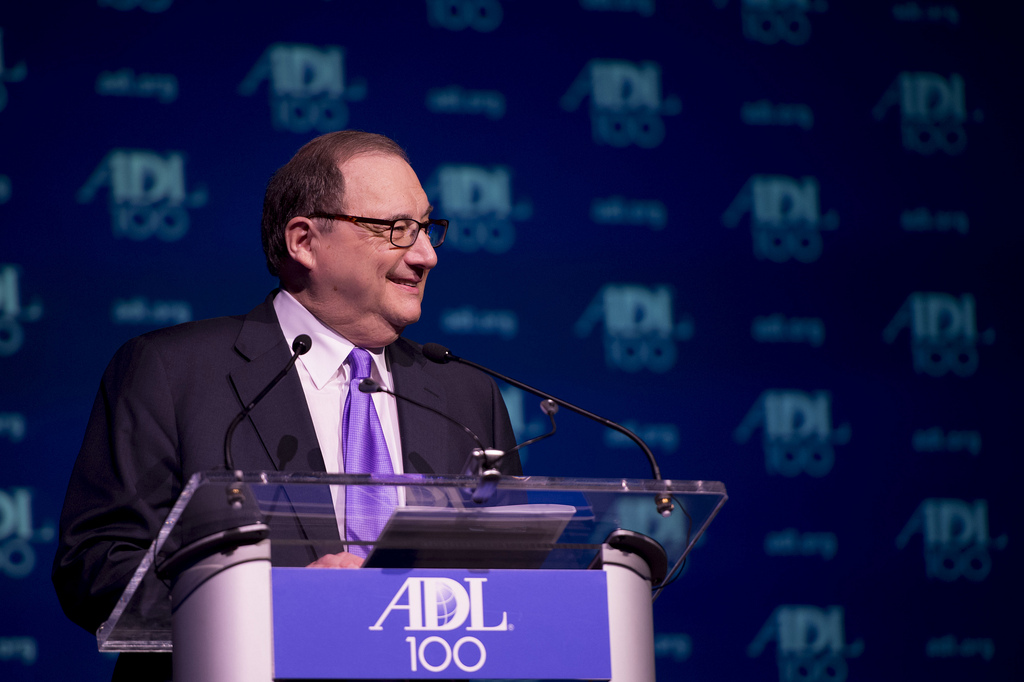
When Abraham Foxman, the longtime national director of the Anti-Defamation League, announced he would retire in 2015, the inevitable speculation about who might succeed him quickly yielded to consensus: Foxman, who has served the ADL for 50 years, more than half of them as national director, is irreplaceable.
That conclusion is spot-on, and not just because Foxman is a one-of-a-kind personality, one who cemented the ADL’s reputation as a leader fighting for civil rights and religious tolerance and against bigotry and hate.
The ADL shouldn’t try to replace Foxman because the role he created for himself has failed to keep up with fundamental changes in American Jewish attitudes, particularly with increasingly diverse views on what it means to be “pro-Israel.”
Foxman has long been the go-to guy for every reporter (including this one) to pass judgment on whether a politician or celebrity has crossed the line into anti-Semitism. Over the years, he has also become a de facto arbiter for many on what is or isn’t “pro-Israel.” But this is a growing problem at a time when the views of many American Jews are diverging from the positions held by major Jewish organizations—including the ADL.
The Pew Research Center’s major survey of American Jews last year brought the problem into focus. It showed declining attachment to Israel and greater opposition among younger Jews to Israel’s occupation of the West Bank. These younger Jews were more skeptical than their elders about the ongoing building of settlements, as well as the sincerity of Israeli government in pursuing peace with the Palestinians. The survey also found that older Jews were more likely than younger ones to say that “caring about Israel” was an essential part of being Jewish.

Asked about these results, Foxman told The Jewish Daily Forward, “You know who the Jewish establishment represents? Those who care.” Of the views expressed in the survey, he added, “I’m not going to follow this.”
Foxman wasn’t alone among Jewish leaders in his dismissive attitude toward the Pew survey. But his words struck a nerve because the ADL’s mandate extends beyond Israel advocacy into combating racism and intolerance. For American Jewish opponents of the occupation, Foxman’s comments and his refusal to apply those ideals in a way that resonated with their concerns were emblematic of a leadership structure that has failed to represent their values, while still claiming to speak for the Jewish community as a whole.
That claim has come under additional pressure as reporters and activists examine the views of major organizations and how they select their leaders and obtain their funding. Supporters of the major Jewish organizations, The Forward’s Josh Nathan-Kazis wrote, are “mostly wealthy donors and local activists.”
During my own reporting on the Pew survey, activists affiliated with J Street’s university arm who are pressing for a two-state solution expressed frustration with Foxman’s remarks. One told me Foxman was a “king with no followers.” J Street U’s board president, Jacob Plitman, told me it is “troubling for us to see Abe Foxman say he’s not interested in what we think.”
Others thought the dismissive tone of leaders like Foxman was an expression of their “anxiety,” as Yehuda Kurtzer, president of the Shalom Hartman Institute-North America, put it, over significant changes in American Jewish attitudes toward Israel.
Community shifts aside, Foxman’s status as a self-styled arbiter of what’s offensive to Jews has been eroded in recent years by some moves that drew heavy and well-deserved criticism. In 2010, for example, the ADL honored Rupert Murdoch, CEO of Fox News’ parent News Corp., with its prestigious International Leadership Award, citing “his stalwart support of Israel and his commitment to promoting respect and speaking out against anti-Semitism.” The following month, Glenn Beck, then still a host on Fox News, devoted several days to a conspiracy-laden attack on liberal philanthropist George Soros, entitled “The Puppet Master.” The broadcast was widely denounced as anti-Semitic. Simon Greer, then CEO of Jewish Funds for Justice, compared Beck to Father Coughlin. Four hundred rabbis demanded an apology, though Fox News chair Roger Ailes belittled them as “left-wing.”
Foxman, though, while rebuking Beck for his “insensitive” remarks, praised him as “a strong supporter of Israel and the Jewish people”—reportedly after receiving a phone call from Ailes.
Foxman’s inclination to coddle the politically powerful came to the fore again last year, when former President George W. Bush spoke at the annual fundraiser for the Messianic Jewish Bible Institute, an organization that trains people to evangelize to Jews to accept Jesus as the Messiah. An array of Jewish leaders and even Bush allies criticized the move, but when Foxman finally spoke on the matter, four days later, he described the ADL as merely “disappointed” in Bush’s decision, adding, “I wish he would not speak there.” It is a marked contrast to his reaction in 2012 when presidential candidate Rick Santorum addressed a similar group, the Messianic Jewish Alliance of America.
Foxman called Santorum’s speech “insensitive and offensive,” but he defended Bush as “a friend who has an abiding love and respect for Israel and the Jewish people.” Three months later, just four days before announcing Foxman’s retirement, the ADL awarded Bush its highest honor, America’s Democratic Legacy Award.
Foxman’s readiness to consider words and actions less “offensive” when they come from powerful allies is all too common, but it underlines the difficulty of anointing a single authority—or organization—to identify friends and enemies of Israel in a changing world. In picking Foxman’s successor, the ADL has an opportunity to reshape how Jewish organizations respond to changes in American Jewish attitudes toward Israel. Its next move will speak volumes about its responsiveness to historic shifts in the community it claims to represent.
Sarah Posner is an investigative journalist. Her website is sarahposner.com

One thought on “Opinion | Do We Still Need an Arbiter of Anti-Semitism?”
Sounds to me like Ms. Posner is an Israel hating Jew. Choosing J Street as the arbiter of anti-semitism is laughable, because anyone with half a brain knows J Street is anti-Israel, and in my mind, anti-semites. But that’s what has become of today’s Leftists/Democrats, they all HATE Israel.